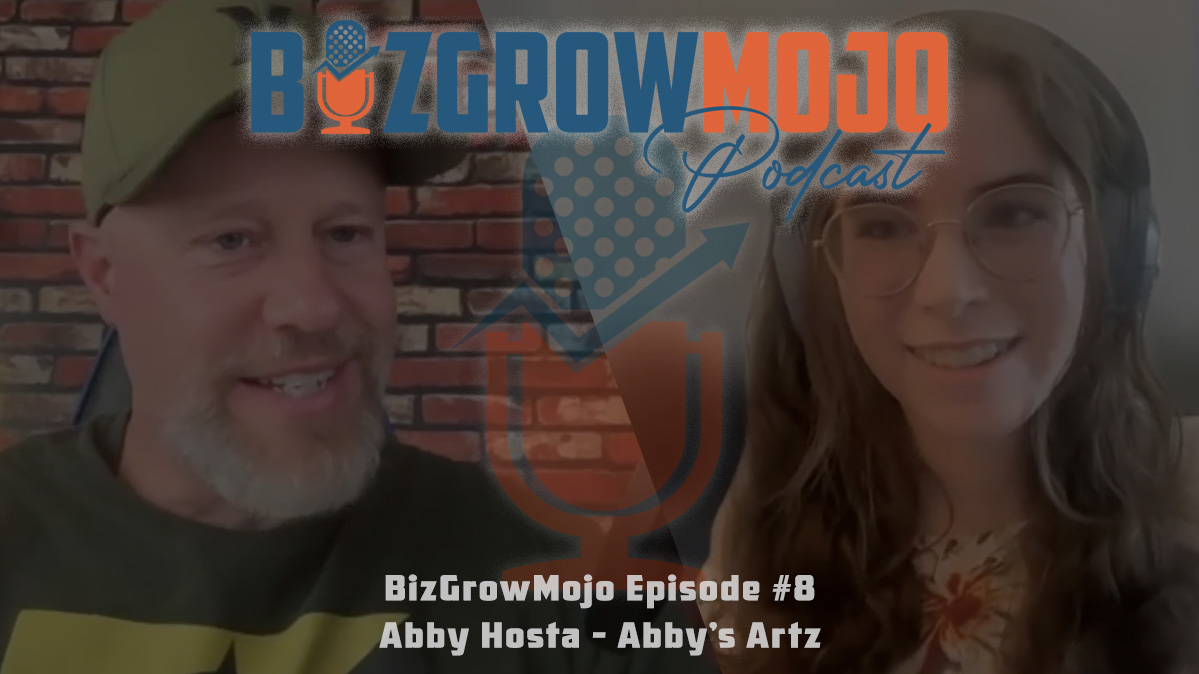
BizGrowMojo Episode 8 – Abby Hosta – Abby’s Artz
From Fine Art to High-Ticket Campaigns for Million-Dollar Companies: The Power of Premium Direct Mail Marketing
1. Episode Verbal Description (Intro)
From fine art to high ticket campaigns for million-dollar companies, the power of premium direct mail marketing. Today, we’re talking with Abby Hosta, a young entrepreneur who has turned her artistic talents into a unique business solution. Abby helps high ticket companies break through the noise with custom direct mail campaigns that combine hand painted artwork with psychological marketing principles. We’ll dive into how she’s making junk mail not junk mail, her strategies for targeting million-dollar businesses, and why she believes the human touch is more valuable than ever in our AI-driven world. Plus, she shares the mindset shifts that helped her build a waiting list of clients and why being young became her biggest marketing advantage. Let’s dive into it.
2. Episode Description (Platform Description)
Making Junk Mail Not Junk Mail: The Art of Premium Direct Mail Marketing
Abby Hosta started as a fine art painter with a waiting list for pet portraits, but realized she wanted to build something bigger than a one-person operation. Now she’s combining hand-painted watercolor art, wax seals, and psychological marketing principles to help high-ticket companies ($1-2M+ revenue) stand out in crowded executive inboxes.
In this conversation, Abby reveals:
- How she pivoted from fine art to B2B marketing campaigns
- Why direct mail with hand-painted elements gets 30% better response rates
- The “lumpy mail” strategy that forces dopamine responses and brand recall
- How she turned being young from a weakness into a marketing strength
- Why she’s selective about clients (established companies selling $10K+ packages)
- The psychology of reciprocity and the “friend or foe” instinct in marketing
- Why she believes AI makes the human touch even more valuable
Abby also discusses the challenges of targeting the right buyers, why she uses LinkedIn for client acquisition, and the importance of providing massive value before asking for anything in return.
Connect with Abby:
- Website: abbysearth.com (no spaces)
- LinkedIn: Abby Hosta
Timestamps:
- 1:40 – From fine art to business marketing
- 8:10 – The problem art solves in business
- 10:43 – Targeting high-level executives with gifting strategy
- 15:42 – Hand-painted elements and scaling with human touch
- 25:22 – Leading with age as a marketing advantage
- 35:01 – Ideal client profile: $1-2M revenue, $10K+ packages
3. Teaser Quotes with Timestamps
Teaser Quote #1
Quote: “My whole plan with the outreach strategy is to just get so much dopamine from when they open it that their brain is literally forced to remember it differently and they want to talk about it and it’s not just, you know, a standard email.”
Timestamp: 12:15-12:26
Social Post Context: This reveals Abby’s unique approach to direct mail – she’s not just sending pretty postcards, she’s engineering neurological responses. By creating “lumpy mail” packages with hand-painted artwork, wax seals, and thoughtful personalization, she triggers dopamine responses that make recipients remember and talk about the sender. In a world where executives are flooded with generic emails and automated outreach, she’s using biology and psychology to create memorable brand moments.
Teaser Quote #2
Quote: “I would sort of lead with my age and explain, of course, you know, how I used all my time and my resources to acquire skills and buy other people’s time so they could teach me all of their mistakes that they made over years, but also just making it sort of the forefront because people aren’t going to notice it anyways.”
Timestamp: 25:43-26:03
Social Post Context: This demonstrates a powerful marketing lesson: turn your perceived weakness into your strength. Instead of hiding her youth, Abby made it her differentiator. She explains how she invested in learning from others’ decades of mistakes, making her youth an asset rather than a liability. The key insight: trying to appeal to everyone (including people who won’t buy from you anyway) dilutes your message. By being authentic and leading with what makes you different, you attract the right clients who value what you bring.
Teaser Quote #3
Quote: “People are always searching for is this person trying to help me? Are they trying to hurt me? And that’s one of my favorite hobbies as well is really just understanding people at a psychological level because it plays so much into the marketing that we do.”
Timestamp: 13:49-14:01
Social Post Context: This captures Abby’s approach to marketing psychology. She understands that our prehistoric survival instincts still drive modern buying decisions – we’re constantly evaluating whether someone is a “friend or foe.” By leading with massive value and using the principle of reciprocity (giving so much that people feel compelled to learn more), she positions her clients as trusted allies rather than pushy salespeople. This psychological understanding is what makes her direct mail campaigns effective where typical cold outreach fails.
4. Full Episode Transcript
The Art of Premium Direct Mail: Making Junk Mail Not Junk Mail
Full Episode Transcript with Abby Hosta
[0:00] Introduction
Welcome to the Biz Grow Mojo podcast. The podcast where we get into real talk about business ownership, growth, marketing, learning lessons, and advice with real business owners. Here’s your host, Ryan Amen. Now, let’s get down to business.
I’m pumped to get this rolling. Let’s go.
From fine art to high ticket campaigns for million-dollar companies, the power of premium direct mail marketing. Today, we’re talking with Abby Hosta, a young entrepreneur who has turned her artistic talents into a unique business solution. Abby helps high ticket companies break through the noise with custom direct mail campaigns that combine hand painted artwork with psychological marketing principles. We’ll dive into how she’s making junk mail not junk mail, her strategies for targeting million-dollar businesses, and why she believes the human touch is more valuable than ever in our AI-driven world. Plus, she shares the mindset shifts that helped her build a waiting list of clients and why being young became her biggest marketing advantage. Let’s dive into it.
From Fine Art to Business Solutions
Abby, how are you this morning?
Good. How are you doing, Ryan?
Good. Hey, uh, appreciate you coming on board here.
Yeah, me too. I mean, I I got my podcast mic. Hopefully, it’s working.
Perfect. Sounds good. Sounds good. So, we should be all set.
Awesome. Well, let’s just hop right into it. Abby, I appreciate you coming on to the podcast. I’m looking forward to hearing a little bit more about your story and what you do. Why don’t you just um why don’t we get started by just telling us a little bit about who you are and what your business does.
Oh, yeah, of course. Well, so I started out, let me see, doing kind of professional fine art, especially very deep in the fine art world.
Oh, cool.
And yeah, well I actually through that I really discovered my love for, you know, marketing and business, all those things. And I just got so into it that I ended up getting a waiting list for a few months actually of people wanting me to do paintings of their pets or whatnot. And I’m like, well, okay, well, I know how to build a business. I know how to market, but I really want to create something that can last bigger than me and also that isn’t reliant on me and one person being able to paint things and pictures and all those things. So, I kind of for sure I moved towards sort of the more business route now, which is where I am now of really just trying to use art as a means to increase business profits essentially.
Awesome. Yeah, that’s really cool. Yeah. I was looking at your website a little bit. Um, what inspired you to really like start a business in art to begin with?
[5:00] The Power of Creative Stubbornness
Oh, yeah. That’s a great question. I I think I mean I would really say honestly just people saying I can’t do it because I I feel like I’m a very stubborn person. So I like whenever somebody says you can’t do it, I’m like, “Okay, well I have to prove them wrong, of course.” And even on for sure and even like on a more societal level as well like a lot of you know women are sort of the minority in business and I think one of my main kind of overall goals is to really encourage especially minorities in business because we usually we see problems differently and we think differently and even on a logical economic level we’re really able to bring in different solutions and really innovate in different ways that other people wouldn’t have thought of.
Okay, cool. Yeah, I like that. What were you doing before you started um a business, you know, with your painting and all that?
Well, yeah. So, I mean, I really was just sort of painting. I mean, that’s kind of been my whole life is just art and painting. Even like since I was a kid, I was just I was just drawing.
What got you started um you know in art and made you really want to like pursue that into something bigger? Was there a a moment where you’re like this is this is my thing. I’m going to turn this into something or did it just kind of evolve into something where you were started making a little bit of money with it and then it just grew from there?
Oh yeah. Well, I mean, I don’t know about you, Ryan, but the first time you earn money like as an individual person just for you, like the money you earned, it feels amazing. It’s like, oh my gosh, it’s like it’s almost such a high I would say and then like you keep trying to chase it because I mean it feels very different. I feel like if it comes from you and you did it, then you know somebody else something that especially with something that you enjoy doing and you’re passionate about makes a big difference.
Oh yeah, I would say so for sure. That’s awesome. I can relate to that. I have a background in graphic design. That’s kind of how I got into business was starting with that. So I can appreciate um you know just uh that uh the drive and and the motivation from you know creating something and you know how that feels to be able to turn it into something that makes money. It’s pretty cool. So how do you how do you make money in your business? What is like what do you charge for specifically?
The Human Touch vs. AI
Well yes. So, also to touch on your point, the passion here, there’s a fly. It keeps getting in my camera, of course. Um, but I mean touching on your point as well with the graphic design. I mean, I think it’s it’s important as well to really like encourage the arts and really make that a big part of business because especially we’re seeing AI, you know, people are going more towards those standardized versions of AI and it’s sort of taking the creativity out. But what’s interesting enough is there’s actually a very tangible return on investment for human creativeness. Like they kind of they bring something to the table, not only from, you know, more more of an ethical standpoint, but also sort of an oh gosh, I’m losing my train of thought. But that’s okay. Even, you know, like economically, they do bring a different level that I don’t think AI can ever really replicate.
Yeah. I mean AI, you know, is kind of building off of what’s out there and, you know, building off of human creativity, you know, at least that’s what a lot of people say. So yeah, it’s like it needs human creativity to, you know, work from to begin with. So yeah, I think there’s there’s always going to be a need and demand for human creativity. And I don’t know about you, how much you played with AI, but it can be difficult to prompt AI to get what you want out of it. you know, whereas I feel like when you’re working with a human being and you have, you know, say you’re having somebody create artwork or, you know, whatever it is, something creative, you know, whether that’s video, um, you know, audio, uh, you know, printed materials, whatever it is, there’s just a different factor when you can work with somebody and say, “This is kind of what I’m thinking.” And they can use their creativity to create that versus trying to prompt AI. you know, sometimes it does pretty good and it’ll, you know, do something that you want, but other times it’s like you can prompt it to death and never get even close to what you’re looking for. So, you I don’t know how how far out we are from that not being a thing, but I’ve experienced a lot of frustration using AI just trying to get it to do what I’m asking it to do. And, you know, you end up asking it 10 different ways and sometimes it’s just like I’d be better off just to do this on my own because this is going nowhere, you know.
Oh yeah.
[10:00] Solving Business Problems with Art
So tell us tell us a little bit about um you know what what you offer in your business like u you know I know you’re you’re making money u you know through your artwork but um you you combine some digital and and printed things to to create kind of a a product out of that. Is that right?
Yes. So essentially, I don’t know how kind of sophisticated the viewers are over here, but if you are just starting out, it’s extremely important and crucial to essentially find a problem and then find a way that to fix that problem. And I think a lot of people what they don’t know about art is that it can solve a lot of problems in business that people are experiencing now. Like for example, going back to the AI example and things like that, we’re really seeing a resurgence of the need for human connection. So you can see it, you know, online with brands acting as humans, you know, kind of the user-generated content you see out there. So people are really wanting to just connect with people. It’s even a survival mechanism. So we’re always sort of searching for that and we won’t be truly fulfilled even at like, you know, a bio psychological level, which is a fancy word. But really ensuring that kind of gap is mainly what I help with because art it’s is one of the most human things you could do and it connects people no matter what where you’re from, what you’re doing, what language you speak and businesses really can help from that because instead of you know an email or something like that if you send out you know more meaningful art piece that gets a completely different reaction from just you know some words that people probably won’t see and we’ll forget like I’m pretty sure let me see I’m a little rusty. I should have looked at the statistics again but I’m pretty sure it was around like a 30% increase of businesses who really like personalize their messaging make it more meaningful that they have each year in revenue compared to those who don’t.
Oh wow. Yeah. Yeah. So how do you help solve that problem in your business?
Yes. So right now I actually just kind of launched this new service as well. I remember I was talking to you about that. I actually I did have to put a waiting list now though because so many people wanted to try it. But I’m probably going to open it again once I sort of get down the scaling basics of that matter. But essentially I’m sort of doing outreach campaigns. So, usually the problems that I’ve noticed and and that’s another tip as well is really making sure you know you’re solving the biggest problem possible for the people who have the most money possible to pay for it. And I actually I solved the problem for myself because I realized, you know, if you want to talk to these big company fancy executives of these big fancy companies, it’s extremely difficult to reach them. And a lot of the means that PE which people do it now, for example, you know, cold outreach, email, things like that, you really kind of get this negative connotation with a company because you’re just using as like this annoying person who’s like disturbing their piece. So, I sort of came up with this gifting strategy. So, here I have this is what I’m working on for a marketing agency. So, they’re targeting HVAC companies at the moment since they’re in their peak season, but I don’t know if you can see it very well. I’m trying to avoid the blurring, but essentially the goal is I don’t know if you’ve seen Seth Goden’s Purple Cow. Have you or heard it?
Yeah. But yeah, go ahead and you know, enlight the audience because I’m sure a lot of people haven’t heard of that.
Oh, yeah. It’s great book. I was talking to somebody quite special to me on just you know his marketing strategies as well and I’m like just read the purple cap because it’s such a great book but it really talks essentially about really making sure that your product is something that people want to talk about and you know it catches their eye and it’s not something that just gets buried and it’s especially vital now because we’re just so overstimulated with everything 24/7 and like the bar is just getting higher and higher of what is holding people’s attention. So my whole plan with the outrage strategy is to just get so much dopamine from when they open it that their brain is literally forced to remember it differently and they want to talk about it and it’s not just, you know, a standard email. And it works really well for those higher up executives because their inboxes are flooded. They don’t really go on online much. So the strategic is kind of like it puts their foot in the door without in like an annoying or pushy way if that makes sense.
[15:00] The Lumpy Mail Strategy
Okay. So tell us a little bit more about how you kind of go about that. Are we talking about an email outreach campaign or a traditional mail campaign and how do you how do you go about you know getting their attention once you know once you get that to them?
Yes. So it’s actually sort of a direct mail sort of like a lumpy mail campaign. I know that’s like the specific term for it.
Okay.
But essentially kind of using the reverse reciprocity, I think that’s the word of, you know, kind of giving back so much that they want to they’re like, okay, they can’t help but learn more about the company and all those things, which I think a lot of people are scared to do as well, like just give a lot of value because they’re like, oh well, you know, where’s their return on investment in this? But we can see like I don’t know if you’ve heard of Alex or Rosie, but some of some of the biggest players in business, they just give so much value and overwhelm their audience with so much value and they don’t even ask for anything back. And that kind of forces that person to want to learn more because people are always searching for is this person trying to help me? Are they trying to hurt me? And that’s one of my favorite hobbies as well is you probably hear it throughout the podcast of really just understanding people at a psychological level because it plays so much into the marketing that we do. And um a really good lesson that I learned I’m I’m sort of trailing off but yeah you’re okay is that people they’re always start they’re always trying to search for if somebody’s a friend or a foe because if they didn’t have that instinct they probably would have died in you know the prehistoric times. So now people are still always searching for that. It’s like okay are you trying to help me or are you trying to take my money or trying to do harm for me? So really ensuring you’re giving that value and starting out with that value ensures you’re off on the right foot and people aren’t kind of suspicious if that makes sense.
Yeah. Yeah. So can you give us an example of how that translates into like the the mail campaign? Like how do you how do you provide that um you know in those in that mail?
Yeah. So I think a really big part is like the handwritten element, the handdone elements because we see there’s a really big trend of using AI scaling all those things. So now like if you really lean into the exact opposite side, that’s what’s really going to stand out in people’s minds because so many people now are kind of flocking towards those systematizations in their business. So kind of really utilizing that hand personal human touch if that makes sense. So you know handwriting adding little like embellishments like wax seals and doing the hand painted watercolor painting. It’s really going to stand out in people’s minds rather than just being another, you know, automated AI text that people get.
Okay. Okay. So, you’ve got like a hand painted uh element to the mailers that go out and you’re doing some cool things like uh the seals and that sort of thing. So, are you are you like customizing a painting per campaign and then like printing it? Are you like you sure you’re not painting in you know each individual mailer? That seems like that’d be really hard to scale.
Yes. So I am working on a scalability system and just really making sure yeah that it that it can be repeatable but then it also has that human touch and what’s neat now even though I it seems like I am bashing AI a lot it does make it easier to have that human touch at scale. So, for example, you know, they they actually have robots now that can like kind of mimic handwritten writing. Exactly. Which is really neat. And just like they can they can research, they can kind of uncover sort of those deep deeper pain points in the company rather than you having to kind of like fish it out yourself. So really kind of relying on that but then not also like completely straying away from being human if that makes sense.
Okay. Yeah, I think so. So you’re utilizing some like handwritten elements and you’re looking for ways to scale that kind of combining um you know the hand touch with technology. That’s really cool. Can you give us like an example of maybe you know something that um you know one of the pieces you sent out and kind of you know break it down for the the audience so they can hear like you know so there’s this part of it that part of it and you know really understand like your product better.
[20:00] Custom Campaigns for High-Value Clients
Yeah of course. Well, I do want to be fair for my clients as well and just making sure because I came up with this very specific strategy and my goal is to not oversaturate it as much as I can. But breaking down the main points and sort of why they work. I think it’s extremely important to again like I was saying Seth Goden’s purple cow making sure you’re not just another cow. You’re a purple cow. like making sure every single element and especially being extremely detail- oriented. It has to be, you know, wowing and eye-catching. So, you know, from the time they open the mailer to, you know, the time like they unbox it and they read it, everything has to be, you know, the best it can be. And just do something differently, if that makes sense. Because I mean I think a lot a lot of business owners they’re really terrified to just do something differently kind of not follow the crowd and but in reality that’s a even bigger risk because then they’re just going to be another person and nobody just wants to buy from another person.
Yeah. Absolutely. Yeah. So um it sounds like it’s really custom for for each client. Is that is that right? kind of like what it is you’re sending and and how you’re going about it.
Yes. So, I do that as well as sort of the customer retention side as well. So, yeah, really just making sure everything is customized to them because since mainly the people I work with, they’re s they’re selling very high ticket packages. So they really want to make sure, you know, they aren’t just an another automated person and they really want to come across that they do care because their clients are so high value.
Yeah. Yeah. So you’re you’re kind of combining art, handmade and handwritten things and really like customizing mailers for for your clients. And what industries do you typically work with the most or or is it just pretty wide open?
Oh yeah, that’s a great question. I would say a lot of marketing agencies and kind of the financial sectors as well and the mainly the consulting side. So kind of like finance, business, consulting and then marketing agencies are sort of my best people because they’re just they’re really working closely with people and they’re wanting to maintain that customer value as much as they can. So it’s probably one of the best ROIs they can make specifically.
Okay. What how big are like most your campaigns that you do? Are they are they pretty small like real tightknit or are you doing you know things where you’re reaching out and sending something to you know hundreds or thousands of people or you know where’s kind of the or maybe it’s a range of all that.
Yes. So I am working with this marketing agency who wants to send at least I think 500 mailers. So it can depend that’s sort of on the larger side, but my main area is to really just go more towards quality and then just spend a lot of time because I had a struggle as well like the first few months of like I was saying before kind of falling into the crowd doing what everybody else is doing. But my main differentiator that I found is my art and really just going more of that quality direction because we don’t really see that with the mailers. It’s very like kind of mass produced and my whole goal is to sort of do the opposite and to make junk mail not junk mail.
Yeah, I like that. That’s really cool. So, really getting into customizing mailing so that it’s just really stands out and you’re not just another, you know, piece of paper flyer that somebody pulls out their mailbox and tosses in the trash without looking at it. I like that. And that’s that’s really I think you know direct mail can be really effective and it sounds like what you’re doing here would really get somebody’s attention you know a lot more so than the typical and you’re really putting a lot of thought and energy and and creativity into it. That’s pretty cool. I like that. So what was some of the like the early wins or breakthroughs as you kind of got this business going would you say?
[25:00] Learning from Your Market
I mean, I would say I think it’s especially important just to like just sit down and have a conversation with who you’re who you’re targeting because I think like we have kind of these ideas of oh they they both love this and then it it just goes the completely opposite direction. But I think just really trying to understand who the best people are for you and what actually they do want because it might be completely different than what you do think. Like I at first I tried I tried selling art sort of like this art rental service with this big paintings but I mean maybe it could have worked very well but this is just more what people sort of wanted if that makes sense and it’s especially important.
I think that’s great advice and I think it’s something that people overlook a lot is actually talking to their target market especially when they’re formulating their plan and you know going to start it if it’s possible to actually sit down have some conversations and say this is kind of what I’m looking to do is something you’re interested in you know because yeah there’s some things that you think you have a good target market and they’re like oh you know I don’t really I’m not really interested in that and then you know you might find something else that they are really interested in that works really well that could kind of change your direction and goal once you get into the weeds of it and actually know and and talk to your your demographic a little bit more, you know, that’s that’s good advice. Um, what what’s some of the challenges that you faced um, you know, as you’ve gotten this going?
Yeah, I think sort of the same thing as well. like I I kind of just kept throwing things at the wall before I really kind of it clicked for me that oh I can just talk to these people and they kind of would let me know what what’s the most painful for them and I’ve heard a lot of people say as well like selling for you is very helpful too because for example if you’re I don’t know if you’re like a gym business and then you make gym services for gym businesses you’re going to have a lot of an easier your time because you know all the little details that people might not know of. So, and like I said before, that’s sort of the the name of the game is just really understanding your target market even better than they know themselves.
Yeah. Yep. That’s good advice. Um has have you found anything yet that’s kind of helped you scale from um you know just getting going to being able to you know maybe do it bigger? Maybe that’s not even a goal. Maybe scaling doesn’t really make sense. I think you you touched on that, you know, you’re kind of trying to figure some stuff out, but I’m just curious, have you found anything yet that’s kind of helped you figure out how to scale?
I’d say specifically for new clients buys really working on your offer and making sure it’s like the most painful problem possible. It’s not just sort of a nice to have. It’s like like I need to solve this problem in order to grow. It’s not like, oh, you know, this is this is kind of nice. And then combining that as well and making it as risk-free as possible because we very extremely risk averse as humans and we kind of we poke at sort of small things that won’t be a big deal and we make them a big deal. It’s just it’s a survival mechanism as humans. So really making sure that people do feel safe buying with you even at like you know that biological level like I was saying and making it just really stupid for them to not say yes.
Okay. Yeah. Yeah. I can see how that you know kind of figuring that out can help you just get more clients and make it easier to you know keep keep building your business up if you if you get the right things in order to begin with. I like that. Um, have you found any marketing strategies yet that have um, you know, feel like are are really working best at this point?
Turning Youth into a Strength
I mean, I think going back I think I keep referencing Seth’s books, but um, because as you can see, you know, I’m I’m pretty young and I realized like I kept trying to hide, you know, that I was young and just sort of like kind of glazing over my age, things like that. And then I sort of started to do the opposite. So I would sort of lead with my age and and so I would explain, of course, you know, how I used all my time and my resources to acquire skills and by other people’s time so they could teach me all of their mistakes that they made over years, but also just making it sort of the forefront because people aren’t going to notice it anyways. And really making sure that you’re leading in the right people and sort of distancing the wrong people is extremely important and has worked very well for me. Because even, you know, if I sort of please those people who don’t think I could do much because of my age, they probably wouldn’t buy from me anyways. And the people who do really buy from me don’t really think age is a limiting factor. So it wouldn’t really make sense to try to get everybody and just sort of have both people but they’re just kind of lukewarm if that makes sense.
Yeah. Yeah. Absolutely. You try to serve everybody and you end up serving nobody. So yeah, it’s good to to to find that the strengths, you know, the the the things that make you who you are and use them as strengths instead of um you know, seeing the we the the glass the glass half empty side of it and and trying to avoid those things just you know leaning into them and and making them just owning it as part of for what you do and who you are. So what have you found that’s helped you gain clients at this point? like what what marketing tactics or channels have you found that have worked really well for you up to this point?
That’s a good question. I would say I think LinkedIn is very helpful. It has been helpful for me of even just getting value, providing value, really making sure you’re you’re seen as that person who wants to help and not that person who wants to take. And like I was saying before, because people they only really trust people who know that, you know, hey, they’re going to they’re going to give me value. They’re going to help me because we’re extremely risk averse and cautious as humans. So that’s really helped me as well as networking and really focusing especially on like how even because it shows up in your body language as well of how I can help you and not just focusing on okay are they going to buy are they going to buy yet like even if you help somebody and they they don’t end up buying that’s a total w because then they might tell somebody else like oh so and so is really helpful they might be able to help you too and then you get the client. So, I think that’s been a really of a game changer mindset for me is just focusing on helping rather than like self-s serving.
Okay. And LinkedIn has been a pretty good place to do that. Do you have any specific strategies you’ve used that have, you know, you feel like has really helped you get clients from LinkedIn or anything like that? Any any um particular methods of outreach or anything like that?
[30:00] Tools, Mistakes, and Finding the Right Buyers
or really just like I said before, leaning into how I could help them first and not sort of trying to pitch slap them, but because I’m sure you get it, too. Like you’ll you’ll connect with somebody. It’s like, hey, I I do websites. Here’s here’s my pricing. I’m like, I just met you. So, yeah, there’s a lot of that on there.
For sure. Yeah, for sure. Did you did you make any uh marketing mistakes early on that you’re like, “Oh, that was a complete waste of time. That’s a good learning lesson there.”
Oh, I’m really glad you asked that because I have. So, I think one of the mistakes I used to make is kind of targeting people who weren’t qualified for my offers and and I would just sort of target everybody and people who might not even even be able to afford what I’m doing. and really like making sure I’m only sort of targeting and talking to people who sell very, you know, higher ticket packages who are doing, you know, having significant revenue already rather than trying to kind of convince people who to give like half of their savings they have because it’s a lot easier and to service wise as well like post-purchase to have people who you know have a lot of money but then you’re getting a little bit of it than to have people with a little bit of money and they’re giving like 90% of their money because that’s a lot of trust that they have to put in you.
Yeah. Finding people in that right buying stage. Yeah. That that can be really important. Have you found any tools that you use at this point or systems that you know help keep things running smoothly and you know just help you do things better in your business?
I’d say notion. Notion’s been extremely helpful for me because you can kind of you can customize it to whatever you want. So it can be a planner. I use it to sort of to track leads or sort of as a summ system where you know you could track different prospects and plan things and that’s been extremely helpful. But I mean do you have any you would recommend for the beavers?
Oh there’s just so many tools out there. I mean, I use a lot of tools specific to marketing. You know, Hrefs is a great one because it can really help you, you know, track things and dive into things. Um, yeah, I always recommend my clients use Call Rail. Um, because that’s a really great way to be able to understand like where your calls are being generated from. So, you can understand, you know, how your leads are coming in, what channels are are actually leading to getting new leads to your website and that sort of thing. of course like Google Analytics and um you know search console and there’s so many of them out there.
You know I might have to write that down myself because that sounds very useful.
Yeah absolutely. Yeah it’s good to be able to track that website traffic and understand it better so you can you know pivot make changes you know capitalize on other efforts that you know might be working and um you know dump the ones that aren’t.
Oh yeah for sure.
The Impact of Business Ownership
So, let’s talk a little bit about just being a business owner and what impact it’s had on you. How how has running and owning a business changed your life, do you feel?
Oh gosh, you kind of put me on the spot. I got to think for a little bit. I mean, I think it does really kind of challenge your mindsets and really show what you’re made out of because it can be extremely grueling at times. I’m not going to lie. Like like I don’t know if you’ve read Atomic Habits, but if you want to chase success and growth, there’s going to be this big period where you don’t have any whatsoever. And people really expect growth to kind of be like this this linear line when in reality it’s like all this effort being stored up and then it just takes off last minute when you’re about to give up. And I think a lot of people are not ready for that, especially sort of with the instant gratification world that we’re in.
Yeah, absolutely. Yeah, I can I can relate to that. Um, do you uh feel like you’ve achieved success in your business now or what does that look like for you?
I mean, I think I would say so. I think so. And I think once you get to the other side, like I was saying as well, of kind of that the curve of, you know, putting all this effort in and not seeing it, but once you get past that, it feels amazing. Like it I cannot describe a better feeling than that.
[35:00] Ideal Client Profile and Business Freedom
Yeah. Yeah. So, how is like running a business? How do you feel like it’s given you more freedoms and opportunities in your personal and professional life?
Oh, yeah. I would say like it really pushed me to be a better person overall because you know if you’re not disciplined if you don’t have everything organized then you probably have a very low success rate with business just because there’s so many things you have to take track keep track of and you have to do it all yourself and hold yourself accountable. So it’s really forced me to develop as a person for sure and wait I don’t know if I answered your whole question.
Yeah. No, that’s good. That’s good. Would after, you know, having a business and and doing what you’re doing, would you go f get a job? Would you ever consider that or is this it? This is 100% for you.
I think this is it.
Personally, I think most people feel that way once they they start their own thing and uh, you know, get the uh the ability to, you know, make decisions about their time and and have a little bit more control over their money. I don’t talk to very many people that say, “Yeah, I’m thinking about throwing this out and going back and getting a job.” So, are there any ways um that you know anybody can kind of uh determine if they’re a good fit for your business? Um if they’re wanting to, you know, they’re considering doing this the sort of thing you offer, you know, who who is a good fit for this?
Yeah. So for the the outreach kind of offering campaign I in sort of the overall I am very kind of selective about who I choose because some people just starting out those people aren’t usually the right fit for me and I know there are services that do fit them very well but people who have more established companies usually around like three or four years doing like you know 1 to2 million in revenue at least and have especially the higher ticket packages are extremely compatible with my offering of, you know, maybe even been like $10,000 or more or even a little bit less, but sort of towards that mark. Usually, that’s what I’ve seen the most return on investment for those companies because they have sort of the sales processes down and they’re really just trying to maintain their customer value and yeah, the customer value as much as they can.
Okay. Yeah, that’s good to know. Um, what’s one tip you you think every business owner or somebody considering starting a business should know?
I would say never give up because like I was saying before, like there can be periods of time where you’re putting everything in and you’re not seeing it yet, but it’s just stored up for a later time and it just goes like a rocket ship.
Yeah. Yeah, that’s good. I like that. Would you do anything differently if you had to start over? um from you know now versus when you first got your business going.
I think I would definitely try to not be vanilla ice cream metaphorically because you know we we kind of like kind of fit and kind of make ourselves a little bit more bland so we could please other people when in reality those people that we’re trying to please are probably not our ideal buyers anyways. So it doesn’t really make sense why we should try to please people who, you know, aren’t even going to do anything for us. If that makes sense.
Yeah. Yeah. Absolutely. Yeah. It goes back to trying to be everything for everyone and then you end up being nothing for anyone. Um Yeah. Any advice for like listeners that are, you know, wanting to do something similar to what you’re doing and, you know, utilize some sort of art um or, you know, something creative that they do to start a business.
Final Advice and Where to Connect
we can always reach out to me personally. So my website is Aby’s Arts and oh gosh, I would say yeah, like I said before, just really be yourself and don’t give up because there there actually is a lot of sort of mental work and personal development work you have to do to be a successful entrepreneur. It’s not just, you know, getting orders and the very sort of businessy things.
Absolutely. Yep. 100% agree there. Um, so where can people go then? Uh, you know, you kind of mentioned it, but what’s the what’s the exact address people can go to learn more about you and your business?
Yes. So, it’s just Aby’s Earth. So, there there’s not like a a space or anything.com. And then my LinkedIn is Abby Hosta. I I post tips and things like that as well on there and just my experience and my journey if people want to check that out. And yeah, those are my best sources I would say.
Okay, awesome. Any any final thoughts for the audience or anything? I think I’ve asked most of the questions. I wanted to to get into and I I really appreciate you coming on to the podcast. It’s been really interesting to hear about how, you know, you’ve created something that, you know, you’re passionate about and turned into a business and you’re making that a success story. It’s really cool. So, we really appreciate you coming on. Um, any any final thoughts for the audience?
I think I think I said everything. I mean, if they want to talk to me as well, they have my website.
Awesome. Awesome. Well, really appreciate it, Abby. Thanks for coming on the podcast. It’s been really fun.
Thank you, Ryan. It was great being on here.
[39:00] Closing
You’ve been listening to the Biz Grow Mojo podcast with Ryan Amen. Make sure you like, follow, and subscribe so you don’t miss an episode. Thanks for listening. We’ll see you next time on the Biz Grow Mojo Podcast.
- Episode 11 – Russ Perry, Founder of Design Pickle - October 9, 2025
- BizGrowMojo Episode 10 – Brand Strategist Asia Dore - October 2, 2025
- BizGrowMojo Episode 9 – Jana Yockey – Garlic Gods - September 26, 2025