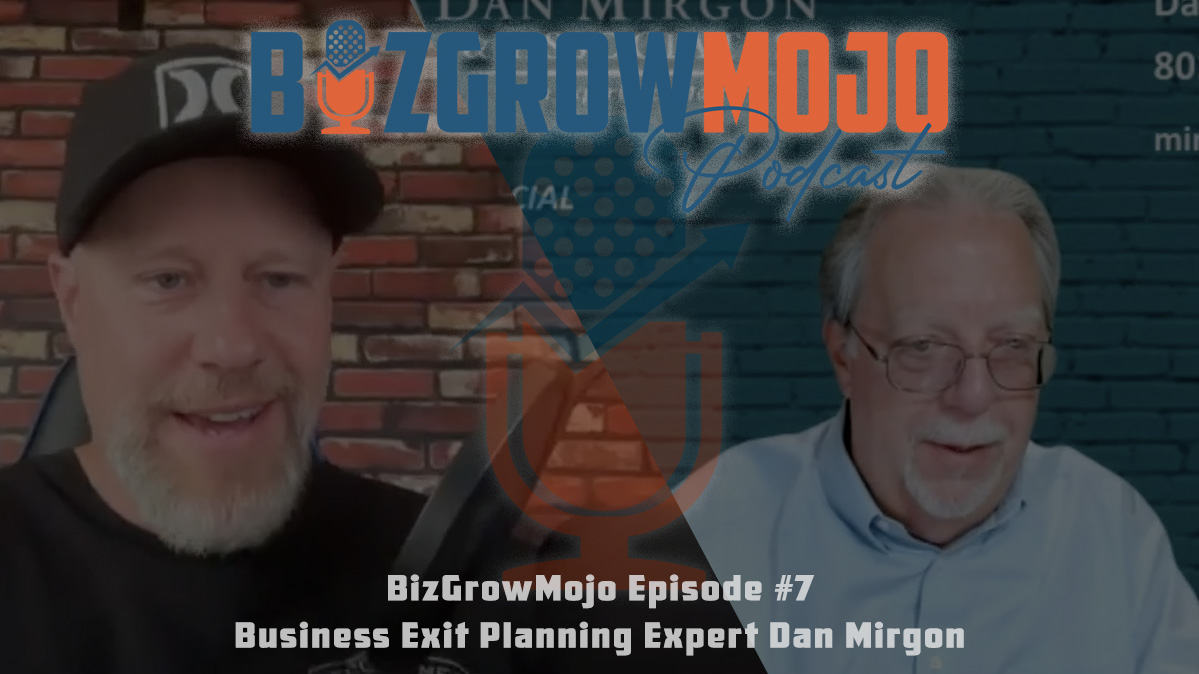
BizGrowMojo Episode 7 – Business Exit Planning Expert Dan Mirgon
Why 82% of Small Businesses Never Sell: Exit Planning Done Right
Full Episode Transcript with Dan Mangon
[0:00] Introduction
Welcome to the Bisgrow Mojo podcast. The podcast where we get into real talk about business ownership, growth, marketing, learning lessons, and advice with real business owners. Here’s your host, Ryan Aean. Now, let’s get down to business.
I’m pumped to get this rolling. Let’s go.
82% of small businesses that go to market never actually sell. Think about that for a second. Four out of five business owners who think they’re ready to exit discover they’re nowhere near prepared for what buyers are actually looking for. In today’s episode, I’m sitting down with Dan Mgon, a certified exit planning adviser who’s been in business strategy since 1982. Dan has started and run five companies, consulted with over 300 businesses, and seen exactly why most exits fail, and more importantly, how to avoid that fate. Whether you’re planning to exit in the next year or the next decade, this conversation will change how you think about every business decision you make. Let’s jump in.
The 82% Problem: Why Most Businesses Don’t Sell
Well, hey, I appreciate you coming on uh the podcast, Dan. Uh it’s great to have you on board here. Looking forward to learning a little bit about your your business and and how you’ve uh been able to uh gain some success in your business and what you have to offer other business owners. Uh let’s start by uh just telling us a little bit about who you are and what your business does.
Well, the short answer is that uh we do business and financial strategy. I’ve been in that game since 1982. Okay. So, I work with the business owner typically in the 500 to 5 million range as far as topline revenue who um recognizes that their business is an asset that needs to be polished and and and built so that someday they can think about selling it. So, it need it needs to be profitable. And when I say profitable, I don’t mean you can just pay your bills. I mean, when a buyer looks at you, they’re going to think you’re you’re an asset they want to think about buying. You have to be healthy as an organization. And you have to be marketable. And that all is kind of the preface to say that 82% of these small businesses that go to market don’t get sold in the first place. So, that to me presents a problem, right?
Yeah. Absolutely. And that’s where you come in to help solve that, right?
To the degree we can. Yes. Yeah. Um, you know, part of part of the answer to that, uh, Ryan is that, um, most of the baby boomers and of which I’m right in the middle, um, kind of got their business, how to sell a business, how to operate a business, thinking back in the late 70s and early 80s when I got out of college. And I don’t know if you’ve noticed or not, but the world has spun us a couple times since then. And things are things are quite different. So, takes quite a bit to to kind of somebody will go to the business broker or they’ll go to the m mer mergers and acquisitions company and say, “Okay, I’m ready to sell.” And by and large, what they’re stating is an emotional, “I want to get out of this thing.” But when you look at the math, they’re nowhere near ready to sell for a price that anybody would accept.
Yeah. Right. What inspired you to start this business?
From Five Companies to Exit Planning Expert
Um well I guess the business has sort of morphed over the years. Um in its current iteration I had been doing a lot of probably for the last 20 years uh a lot of one-on-one executive coaching with business owners and leaders right and I ended up in a conversation with a doctor a few years ago and I asked him so how long you going to run the practice and what are you going to do afterwards? two very simple questions that most people should have an answer to, right? He goes, “I have no idea. I don’t know what it’s worth. I don’t know what I would do afterwards. They’re going to have to carry me out of here.” And I thought and I thought, “Okay, he’s he’s thought that through a little bit.” But but but I also realized that I’ve been hearing some version of that by most of the people uh that we were t we were kind of hanging around and talking to. So I looked at the industry and I figured out I mean I I’ve got estate planning and financial and management all that kind of stuff in the background all those credentials but I realized there’s a lot of folk out here who want to be in the exit planning space who haven’t started and run five companies haven’t raised money haven’t sold haven’t consulted with 300 companies and we’re a little different because of that Right. Yeah.
Um and so I’m not in it for the assets under management when the sale happens. I’m in it for helping the the little business guy get to the big business guy. So you can answer the question if if uh you know his biggest competitor walks into his office tomorrow and says, “Ryan, I want to I want to buy your company. Here’s my offer.” Ryan needs to be able to say, “Well, thank you very much, whoever you are.” Um, but I know we’re worth this much and here’s why. And if you can’t answer that question, you’re guessing. Yeah. And guessing doesn’t get you real great results.
[5:00] Business Model and Early Lessons
Yeah. Absolutely. I want to go come back to this a little bit more about, you know, how you’re helping business owners. But before we get too deep into that, I’d like to talk a little bit about how you’re finding success in your own business, if that’s all right. Um, yeah. Yeah. So, how does your business actually make money? Is it like a is it a flat fee? Is it an hourly rate?
Uh, we charge a retainer on a monthly basis. We negotiate that in advance um of each segment of the work we do. Um, multiple services have different pricing ranges. Um, and some of that has to do with the size and complexity of the deal. Some of it is simple straight out executive coaching, but we’re still doing a lot of pretty standard flat rate for that.
Gotcha. What were some of the early wins and breakthroughs that you had like building your own business?
H well I don’t know that I would have started five companies if it were all wins but um uh hard knocks learn learning that tenacity is a better definition for stubbornness right uh stubborn means I’m obstinate and I’m rude tenacious means I’m strategic yeah and uh one of the things that that I learned several of years ago, probably 20 years ago, was that not everybody’s like me. And the more I’m allowing them to be them, the more I’m I’m actually hearing what their challenges are. And I don’t I don’t sell, okay? I I don’t do peddler. I’m not here to push anything down anybody’s throat. I’m here to solve problems. And if I had had me back in 1980 or 90, things would have been completely different.
Yeah. Yeah. What are some of the challenges you faced in just growing your business to this point to where you’re doing what you do?
Yeah. Um not giving up certainly is is the deal. Being married to the brightest person on the planet who keeps encouraging me. Uh, I’m a high D driver guy and if if if it’s not working, I tend to want to go over here and do something else. And just being able to to hear from her, um, got a great idea. Let’s hang in for a bit. Hang in for a bit. Can be hard to do.
Well, yeah, it takes sometimes being willing to listen to this with an external voice when, you know, particularly guys who are driver types think we have all the answers. Yeah. And it’s hard to not know some or it’s hard to know sometimes when to pivot and when to to hang in longer because, you know, you don’t want to spend too much time on something that is destined for failure. you know, it it make when it makes sense to pivot, but at the same time, a lot of times if you don’t hang on longer, you won’t get to that point of of success.
Yeah. It it’s being able to discern micro movement versus stagnation. Yeah. And micro movement still is the ball is I mean, you’ve seen the golf shot where it’s sitting on the lip, right? just waiting and then all of a sudden it tips over versus the one that never does. Yeah. If you don’t see micro movement, um sit down with your yellow pad and come up with a new plan.
Marketing Evolution Over 43 Years
Yeah. Yeah, that makes sense. So, what marketing strategies have you used in your business that you found that have worked either in the past or or now?
I think that world has changed significantly in always is it seems 43 years. Uh But things don’t really change in the global sense of of things. I It used to be the law of large numbers. Um 2,000 piece of mail a month. Direct mail got you. Okay. 30 or 30 40 leads. That was that was know the the 80s, right? Yeah. Um technology has changed, COVID has changed. Um just the the just the dynamics of business has changed in that um it takes a lot more you know they used to say takes seven touches before you become top of mind. Yeah. Now it depends on who you listen to it could be 30. Yeah. Okay. and and just being allow allowing yourself to let kind of that frog in the pot stew for a bit and uh you know for impatient driver type that’s tough work man.
[10:00] Centers of Influence vs. Direct Response
Yeah absolutely. Do you find there’s a when maybe you first reach a a customer that they actually contact you? Is there a kind of a typical timeline?
It depends on how they get to us, Ryan. Um, to be brutal about it, I don’t get a lot of direct response clients. What I get is um centers of influence introducing us because we’ve invested the time, you know, we’ve invested the time to have a clear understanding of what that advisor, you know, what their what their skill sets are, where the boundaries are, the limits for that. and then um being able to bring new fresh proven concepts to that conversation.
So would you say that a lot of your current business that you get now comes from re referral sources? Is there anything else that you’re finding is working well?
Working well or working at all? Uh um you know I still have um I I post articles every week on LinkedIn. Starting to do the same thing now on Alignable. I’ve kind of returned to Alignable after a um I don’t do direct email direct mail campaigns anymore. Um, somebody spoofed somebody somebody hacked our account and that they burned up our list. And if if I buy a list now, most of these most of these mail service companies want to prove that everybody opted in. And I’m not I’m not about to lie to anybody about that. So, you know, I guess that was a telegram that said, “Hey, don’t do that line of work anymore.” But yeah, it’s, you know, I’m still I’ve retired twice. It’s not all it’s cracked up to be. I can’t sit around and do nothing, right? And I have all this experience and all these tools and I like helping people. So, that’s kind of where it comes off for me. And if I can if I can just build, you know, the firm comfortably and my wife and I can travel and take care of the grandkids, I’m a happy guy.
Yeah. Yeah. What more could you ask for, right?
not have to work at all.
Well, but you said you came back.
I have. Yeah. Well, yeah, we we experienced breast cancer three years ago. Oh, okay. So, you know, part of this is she’s she’s doing fine so far right now. Thank you, Lord. But, uh there’s always more trips and more of this and that. So, yeah.
Yeah, I hear you. Sometimes you got to write your retirement plan in pencil.
Sure. Yeah. race it, come back and adjust it, pit it later.
The Purple Cow Strategy: Standing Out From the Noise
Um, do you find anything that works particularly well once you, you know, have somebody interested in your services that seems to kind of close the deal? Any any particular thing that you’re talking about or doing that seems to kind of speed that process up?
I think and I just got off a call with a a new bookkeeper who just launched his practice and and this topic came up how to differentiate yourself from all the noise, right? Yeah. And it’s getting louder every day. Absolutely. Everybody is a label, right? You go to a you go to an event and everybody goes, “What do you do? What do you do? What do you” What they’re listening for is the one-word label they can put in their mind. You’re a marketing guy. You’re an insurance guy. You’re an attorney. You’re a investment guy. They can categorize you and move on. I started doing something the other day that’s probably going to I’m going to say to lay this out and everybody’s going to go, “Whoa, I got to steal that. Feel free. Just send me money.” Anyway, uh I said, “Do you want the two second answer or do you want to know what I do?” And the first time I did that, the room kind of stopped and went, “Huh?” Because they weren’t paying attention, right?
Interesting.
And I said,”I can tell you in two seconds the label and you won’t know jack about Dan or I can spend 15 seconds giving you a highle overview. Which one do you want?” And I made him choose. And it goes back to Seth Goden’s book, The Purple Cow. If you’ve never read it, you’ve got to. Seth Goden is a major marketing oh yeah expert brilliant thinker but his book that he wrote a bunch of years ago now called the purple cow lays out this idea of you let’s call me a business coach business coach business coach business coach business coach business advisor business strategist I’m doing ostensibly well I’m doing it better but I’m doing ostensibly the same thing, but it made him stop and go.
[15:00] Vision, Mission, and Strategy
So his his thesis is you have to be just different enough that people stop and go, what does that mean? You have you haven’t engaged them. His picture, his mental picture, his storyline is you’re on vacation doing a road trip with your family, driving through farmland and ranch land, and there’s cows and there’s cows and there’s cows and there’s cows and there’s cows and you turn a corner, go over a hill, and all of a sudden sitting in the field. What do you do? You put on the brakes and get out and look and you go, “What the heck is that thing?” You’ve engaged with that cow and you ignored all the others. just because simply because it’s different. So do that and you’ll stop being a commodity.
So do you do you feel like um do you go by a different label like than you know business coach? Do you feel like that’s important kind of that that title of how you define yourself and refer?
No. Um, certified exit planning advisor is is sort of the label that labeled Azure out of seven different credentials we have. But, um, what do you do, Dan? We we focus on strategy for the business owner. Everybody’s chasing tactics, okay? And when you’re done with the fads and the trends and celebrity worship and your uncle Fred’s advice and you need real real results, that’s what we do. So I call it business and financial strategy and they have to go together and they’re different than what you’ve probably heard.
Okay. Interesting. Yeah. Um something.
Yeah. No, no, that’s interesting. But but but it’s the point is you’re thinking about where that goes now because everybody has this road of standard in our conversations. This is where I’m going to go. This is what they said. I can just move on to my next standard whatever thought. And if you can’t stop them, you’re never going to engage them. Got to have something to different to to draw their attention away from just moving on. And you’re still a cow. You can probably get milk and leather and meat from it, right? But it’s a different color. Why? It it creates what’s going on kind of questions.
Absolutely. Yeah, that makes a lot of sense. So, in your business, have you found any tools or or um systems that really make a difference and and seem to be the differentiator to help you keep things running smoothly for our own operations?
Yeah, we use the same tools that we recommend to our clients. Um, so um I mean Outlook, all the all the junk that goes on with that, but um I use EOS or entrepreneur operating system comes from a book called Traction by Gino Wickman that he wrote in 25 years ago. Is this a system?
[20:00] Vision vs. Mission: Understanding the Difference
Yeah, it’s a system that’s pretty much taken the business space by storm for the last 20 years. And really, it’s a simple matter of creating your vision and and it it makes you understand and and that system doesn’t do it. It kind of goes along with my philosophy. Mission and vi or vision and mission have to be laid out first. Vision is the strategy. mission is the plan. And so what’s what’s interesting is I always laugh when I go into a business and behind the receptionist wall or receptionist desk on the wall is their mission statement. We strive to be. I don’t care what you strive to be. Why don’t you just be okay? So here it is. Your vision is where you’re going to go. Jack Welch when he was running General Electric used to drive his leadership team crazy because every time they’d come up with something, his first question was, “So, Ryan, how does that help us fulfill our vision?” Vision is where we’re going to go, why we’re going to get there, what are we all going to gain when we when we arrive. The mission then is it’s kind of like we’re going to we’re going to go to war on this topic. What are the individual battles? How what are the resources we need? That’s the mission. Okay. Yeah. If if you get that figured out and you stick to the vision, people engage with it because you’re telling them about it all the time. They’re going, I like this. I get I get some of the reward at the end. Right. Stop being a selfish jerk and share with the people that helped you make it.
Absolutely. Yeah. Yeah. That makes sense. You know, I think it it sounds like it helps, you know, keep a better keeps you on track better for the ultimate goal. You know, I think a lot of business owners kind of flounder around with their mission statements and, you know, what they’re because they don’t have that clarity.
And you know, u Goldman Sachs 1000 and SPDC and SCORE and all these books that you can read on what you should do, great. But they’re tactics and they have to be secondary to this to the reason you’re in business. And sometimes the tactics change the times. Absolutely. But it should your vision. Yeah. Sometimes your vision needs to be refined. Sure. But why am I doing this? Simon Senic dealt with that in, you know, his book of what’s your why? And your why speaks to your vision. Why am I here? What am I trying to accomplish? And I think there’s myopic thinking for a lot of people. I’m going to be a businessman and I’m going to start this IT company and I’m going to turn it over for $40 million next week. Yeah. Good luck, Sparky. That’s not That’s not reality. Yeah. Oh, but my know this guy over here that did this. Yeah. Out of how many? Yeah. Why do you think you’re hearing about it? Because it’s so freaking aberrant. Yeah. Right. You work you.
Quality Over Quantity: Building Real Value
And the problem that I’ve seen and I’m just going to loiate here for a minute. The problem is everybody wants growth. Everybody wants more. every way. And yeah, it’s endless and it’s foolish because at the end of the day, if this is what I’ve been building and this thing’s a piece of garbage and nobody wants to buy it, I’ve just sold a bunch of garbage, right? But if I build quality into the system and I maintain the quality and the relationships and the the fun of working here, growth’s going to happen generically. People are going people are going to go, I don’t know how you guys are doing this. How do we do this? How do you do that? You can’t you can’t be us. You have to be the best you you can be. Now, that’s a euphemism. That’s a stupid statement for a lot of people, but you got to actually build quality and let the quantity come second.
[25:00] Smart Side vs. Healthy Side of Business
Yeah. People get too focused on the numbers sometimes of we have to grow to this, we have to do this and it’s like if you’re not serving your customers and providing something of value to them because we read it in a book or it was in our college class or what and that’s what we think is the checklist next. Yeah. Exactly.
There’s a there’s a guy named Patrick Lencion wrote wrote the book five dysfunctions of a team. If you haven’t ever read it, it talks about building trust in all the levels of your team. Thanks. He wrote another book called The Advantage. And in that book, he lays out this idea that every business has two sides to it. A smart side and a healthy side. I don’t know what kind of time frame we have here, but
Oh, you’re good.
The smart side is everything we just talked about that you learned from the business school and your, you know, your MBA programs and all that stuff. You’ve got to have it. You’ve got to have somebody actually doing the books who actually knows what they’re doing. You got to actually have quality operations and production and delivery and all that stuff. But you’ve also now got this other side of the business called the healthy side. That’s where there’s high morale, there’s high retention, there’s there’s motivation, there’s this stupid little threeletter word called fun, right? Yeah. Absolutely. Companies spend 90% their time on the smart side of their business because this is what they learned in college or this is what they hear in the press. This is what this guy did. One guy represents the entire industry. I don’t think so. Yeah. Okay. But you spend 90% of your time over here and 80% of your success comes from the healthy side. Exactly. Your people your employees and your customers are sticking around is that side not the other side. So people, you know, when we when we talk to people about hiring us as an executive coach or not even the value enhancement, trying to sell the business, getting the organization under control has has everything to do with getting that leader to think like a CEO instead of a busy manager or somebody who’s guessing their way through their braille business plans are not. And that works for blind people but not for the rest of us, right?
Yeah. Absolutely. Does that make sense?
Yeah. Yeah, it does. Yeah, I agree with that a lot. I think I’ve seen situations where, you know, people get too focused on the other side and it doesn’t it doesn’t help the business grow. You know, as much as they think it’s helping them grow, it doesn’t.
I love the bricks in the background, by the way.
Oh, thank you. Yeah, it’s actually wallpaper, but I shouldn’t I shouldn’t tell anybody, I guess, because it looks pretty real. It was really easy to install.
I got green, too. I got green bricks, man.
Ideal Client Profile and the Three Phases of Business
All right. Well, I appreciate you, you know, diving in a little bit to, you know, some of your successes and some of the things you’ve learned. Let’s talk a little bit more about, you know, your offering and what you do for for business owners. Who’s who’s the best fit for this? And you, I know you gave a a kind of a price range, but is there like an industry? Is there, you know, certain type of business or personality type that fit this and and makes this work better?
Um, yes and no. Um, am most comfortable dealing with people who have were sort of on the nearing the the back half of the game. You know, they they’re they’ve been in the business, they’ve owned it, they run it, and they see an exit coming, and they know that they’ve got to do something substantial to make it actually work. So I I kind of break I kind of break the phases of business ownership down and I deal with the second and third. So the first one is the the startup to survival, right? If you can make it out of startup and survival, you step into the second act of the play really called significance. And this is where most people sit and then they think they’re going to step over into sale. the third phase, the third act. The problem is they’re not ready emotionally and corporately. And when we say not ready, it’s not just the financials. You’ve you alluded to that earlier, but there’s four other areas that we call intangible capital that have to be strong. your customer base, your staff, your leadership structure, and your organizational culture. If those five and you add the financials to that don’t fit with the buyer, you’re never going to get an offer. Okay? So, I have found more comfort dealing with people who have, let’s say, 500,000 of recurring revenue up to maybe five million. Um, they recognize that they’re five, six, seven years from needing to do that transaction.
[30:00] Assessment Tools and Valuation Methods
And so, we use tools to do we start off typically with a DISC and driving forces assessment to figure out who that individual is. We’ll ask them do a strengthfinder assessment so that they know. So now we have the core characteristics of their person. We know how they communicate and we know what drives them. And when that happened to me, I went, “Holy cow, that’s why I’m frustrated with this thing and that kind of thing.” And I figured out how to adjust to that and become a little more peaceful, right? Peaceful. And then we do this celibility assessment. Pardon me. where there’s 30 or so questions, put the numbers in and it gives us a report in eight different areas on a kind of gas gauge scale and blends it together and says if you’re in the 50s and you got up to the 80s, your value would go from here to here. and it goes based on their NISC code and the industry u uh I guess the geography is a pretty reasonably valid valuation. So what I’m doing is I’m I’m working with a lot of bookkeepers and accountant firms who don’t offer valuation or business enhancement. We do that assessment for free and then we go into coaching when it comes time to here to here are the holes in your boat and if you don’t want to drown here’s how we fix.
Yeah, absolutely. Now, I know that’s, you know, the valuation is a fairly complex factor and you just talked a little bit about some of the, uh, you know, the the things that go into that, but is there kind of a rough, you know, uh, revenuebased estimate that a business owner could could get that, you know, give them a little bit of an idea of what their business might be worth, just, you know, kind of based on their their recurring revenue or their their profit margin.
um trying to decide if I want to go that route or not. The reason we use this particular tool and there’s several tools out there where you can go to the web and whatever. Um there are there there are calculators on the internet where you can put the number in. I don’t know that I would stand behind those numbers. Okay. The reason I use this tool is because it goes out to deal stats and biz stats and some of the actual transaction kind of databases based on NAC code revenue and geography and says these are the kind of deals that actually have been happening. So it’s not a a a projection formula, it’s a what’s really going on on the market formula, right? kind of like with real estate based on what’s actually sold, it’s comps, right? Right. In real estate. Yeah. Uh and then from there um when we add that with the components of what’s going on with the rest of the organization um we can see where you know the typical transaction right now is about three times IBIDA.
Understanding EBITDA and Seller’s Discretionary Earnings
Okay. Okay. Can you explain what how that works? what IDA is for, you know, people that may not know.
Um, IDA is a number that your CPA is not going to explain to you, but it’s earnings before income tax depreciated and depreciation allowances or amatization. Depends on the size of the company. Others will be doing what’s called SD or sales or sellers description earnings. Both of them are close. the math a little different, but the basic idea here is on your balance sheet, you got income, cost of goods sold, operating expenses, net profit, right? Yeah. The cost of goods sold, probably can’t do much about that as far as adjusting it, but the operating expenses, that’s one where you have to really take a good look at it. So your CPA will give you an IBIDA. So which means your your cost of goods, your expenses are high so that your tax bills low. Okay? So they tell you go ahead and take that, you know, resort property in Tahoe and call it a business expense. Just make sure you get your team there once a year, right? And write it off. Go ahead and pay yourself an extra hundred,000 a year. and customary, whatever. But the buyer’s going to walk in and go, “Well, um, no, I’m not paying for Tahoe.” Yeah. I’m not and I’m not paying for a puffed up salary and or a list of oddball stupid things I’ve heard over the years.
[35:00] Tax Strategies and Exit Planning
So, some of those things might recommend aren’t necessarily the best for approaching the exit.
Actually, no. Because what’s going to happen is if I’m a buyer, I won’t, you know, we walked in and we made that offer. We’re gonna we’re gonna dig into your books. And if we dig into your books and we find fluff, um, what else are you hiding? Right. Is there any way displays or or or projects an ethics issue?
Yeah. Is there any way that, you know, you would recommend to somebody that’s maybe approaching the sale that they’re doing everything they can to try to, you know, minimize their taxable income and that sort of thing? Maybe they’re, you know, doing some of those things. Is there anything you would recommend doing, you know, approaching that sale or, you know, thinking about it down the road to start changing, you know, anything specific?
Yeah, there’s a lot of different, well, not a lot. There are several different ways that you can minimize the capital gains tax on a business. Um, all of them have what I’m going to call tentacles type to them. Qualified business investment, things like that. uh you reccharacterize the the stock in your company and when you sell it then you’ve got some limitations on how you can use that money for five or 10 or now 15 years and assuming that you don’t do it wrong then you not have to pay the capital gains tax you wrong it all comes back and you pay it all at once um how do you get out of the company taxfree give it to a charity. Simplest answer, but you better be able to prove donative intent because the IRS will look at that as a as a pass through to try to save tax or eliminate the tax. Hide from the tax is a better way to think think about that. So, there’s a couple of different ways that you can pre-think and should be prethinking that with a with a qualified tax attorney. when you’re thinking about taking the ownership from, you know, a single member LLC or or an S corp over to a C corp for for a strategic purpose, right? Those kind of things. And yeah, there’s ways to save some tax. I I don’t know that you can get rid of all of them.
Okay. Okay. Yeah, that’s good to know.
Young Entrepreneurs and Fluke Successes
Um, now it sounds like you work with a fair amount of people that are kind of approaching, you know, maybe retirement, uh, you know, planning and and looking to exit in that way. Do you work or see very many younger owners that are, um, you know, working to plan an exit or um, you know, early early, um, stage entrepreneurs that are kind of focusing on that from the beginning and wanting to build something to sell that intent.
I I I do talk to them. Um I tend not to work with them, but I understand how to help people. Just does that make sense? Yeah. So in that case, generally what’s going on is they they’ve had a and and I hope they don’t get offended by this, but a fluke success, right? The the traditional company takes years to build the success and build the value and get the thing. But a 30-year-old that has the IT connection and the idea inspired, all of a sudden, boom, somebody big comes along and says, “I’m going to buy that for 5 million bucks.” Right now, they’ve got $3.5 million left after all the cost to get out of the business. And they’re sitting here going, “Now, what do I do?” Well, $3.5 million is a nice number. Yeah. Is that the only number? What if you took a portion of that, guaranteed yourself a retirement in case something else goes wrong, put the other part back into um I don’t know, helping small companies do what you did or do something different. And it’s in that it’s in that second iteration of running the business that I’ve seen some of these folk actually learn the difficulty of running the business because the first one was a fluke. It happened to them. They didn’t It didn’t It didn’t wasn’t part of their long their initial strategy. It was their hope. But now you got to deal with people. Now you got to deal with and it’s it’s not flukes does lightning generally doesn’t hit twice in the same place, right?
[40:00] Preparing a Business for Sale
[40:00]
Yeah. Absolutely. Second, um recognize that your job as the owner of a business is to be a humble servant warrior. What do I mean by that?
You’re you might be brilliant, but it’s the brilliance of others that’s going to make it work, right? Humble servant and warrior. You have to fight for the deal. You have to fight for equality. You have to fight for what’s right for the company and the people that work with you, not for you. Get rid of your Napoleon hat and make it a team sport.
But once you you’ve got that, you got to really focus on what am I trying to do here? Build an operating system inside the company.
The Harsh Realities of Exits
Actually take a vacation, the company will run. And then third, I guess recognize the hard cold facts of this. Half of the companies that start this year won’t be at a transaction table because of either a death, a divorce, a disability, or something called a disaster. Can you spell COVID? Right.
So, think about a pool of a thousand companies. You’re now down to 500.
500 who make it. You have to realize a good portion of companies. I have a paycheck company right now. If I die or quit working, the company stops.
If I have an asset-based company, I’m building a management team. I’m building something that’s going to get sold and transacted.
Lessons From Founders Who Exit
[45:00]
Um, there was a reason the lightning hit you. Probably wasn’t your stellar personality altogether. Being the humble servant warrior says, “Okay, now I’m gonna have to go out and learn how other business works.”
And so there’s a lot of folks in that in that range who may take a rollup or they might do, you know, the scale up where they’re going to go off and find—there’s a guy and his wife. Shelley and Rob Walling. She is a psychologist, PhD. He started and ran an IT service and it grew to this monster and he sold it.
She chronicles the psychological challenges of selling a business and going through the deal and that kind of stuff and the what’s-after that they weren’t ready for.
You’ve got to start thinking okay if this thing sells, who could I go help? What should I be doing? And it doesn’t have to be necessarily at the same intensity level as the first one, but it could be a lot more strategic and discerning.
Navigating Earn-Outs and Deal Terms
Well, and the first sale, you learn a lot. Most of the people who actually do transact end up with some kind of earn-out or some kind of challenge that they don’t like. Very seldom anymore do the private equity guys walk in and write you a check, take all the liabilities and let you go home.
Okay. Why is that? They got smart. Learned hard knocks.
Well, if I’m in the private equity game, the last thing I want to do is assume your liabilities and your risks that you weren’t professional or smart enough to figure out how to deal with.
So, they may not even give you an offer. But think about Ryan’s built this company and he’s got everything ready to go except we don’t know how his company runs. Maybe I need to incentivize Ryan in the deal to stick around for two to three years to help us through the transition.
My neighbor is a veterinarian. He just two months ago finished his four-year earn-out. Wow. He had a great practice. The big guys came in, bought him out, but he had to work four years. It’s a long time when you’re an owner with no teeth, because they were driving this.
How frustrating would that be for you or I? Oh, I can imagine.
So, you got to think about the deal in advance. What terms can you or should you accept? Sometimes an earn-out is not a bad thing because I care about my team. I care about the momentum of the company.
Sometimes it’s a roll-up concept where they’re going to buy all my stock, but they’re going to ask me to put 30% back of this new company stock and stick around for five years so we can take their checkbook and grow the thing. Not a bad transaction. It just depends on what you’re trying to do.
Solopreneurs and Exits
[50:00]
Do you see very many solopreneurs trying to exit? I think it depends on the nature of their product or service, the value of what they’re doing. But if they could be just considered another X or Y or whatever, nobody’s going to buy a paycheck.
What type of business structures do you see with a solopreneur that seem to work well for an exit? I don’t care what their structure is as far as the nature of the corporation or LLC. I think part of that has to do with are they willing to be bought and brought into a bigger pool.
You’re good at making this, but we make all the rest of it. If we bought your stock, gave you a chunk of money and six months off and made you come back and work with us, would you do that? Not a bad move for a lot of people. But if the entrepreneurial bug is strong, they’re going to be very, very frustrated.
Thinking Like an Asset, Not a Paycheck
What is one marketing tip more business owners need to hear? Think of your business as that shiny asset that’s going to be sitting on a corporate conference room table lined up against 55 others. Why should they pay attention to yours?
It’s not that I’m ready to sell, it’s that I know the value of my company. It changes how I make decisions and operate it, doesn’t it?
So if I think of it not just as my paycheck but as an asset, I’m going to find more ownership in the ownership role.
Final Advice for Entrepreneurs
What advice would most business owners who’ve exited give to themselves if they started over? Think about the end early. Remember half of them aren’t going to get to the transaction because of those four D’s: debt, disability, divorce, and disaster.
So, you have to mitigate that stuff to the degree you can. And you have to really understand the nature of your business. Are you a solopreneur, paycheck kind of company? Are you intending to sell this thing? Document your processes and systems and have an asset that can be sold.
Play it out in your head. What’s this supposed to look like in 10, 20, 30 years—or five or ten? If you think of it that way, you’ll be more careful and discerning when you make decisions now that could impact the future.
Wrapping Up and Next Steps
Where can people learn more about you? Top right corner of the screen: manggonconsulting.com or 801-870-6463. I don’t bite. Let’s figure out if you’re wrestling with something. A likelihood I’ve seen it. And if I haven’t seen it, it may not be a real problem.
Is the beginning too early? No, but tomorrow is too late. Yesterday is probably better. Start sooner than later.
I don’t have your answers, I have your questions. Let’s figure out what you should be wrestling with so you can get what you want out of the company.
- Episode 11 – Russ Perry, Founder of Design Pickle - October 9, 2025
- BizGrowMojo Episode 10 – Brand Strategist Asia Dore - October 2, 2025
- BizGrowMojo Episode 9 – Jana Yockey – Garlic Gods - September 26, 2025